
Field Note
Wind Against Tide: Fix a Bad Fluke Drift Before You Change Baits
A practical Northeast fluke guide for diagnosing wind-against-tide drift problems, restoring bottom contact, and deciding when to move instead of changing bait.
Quick take
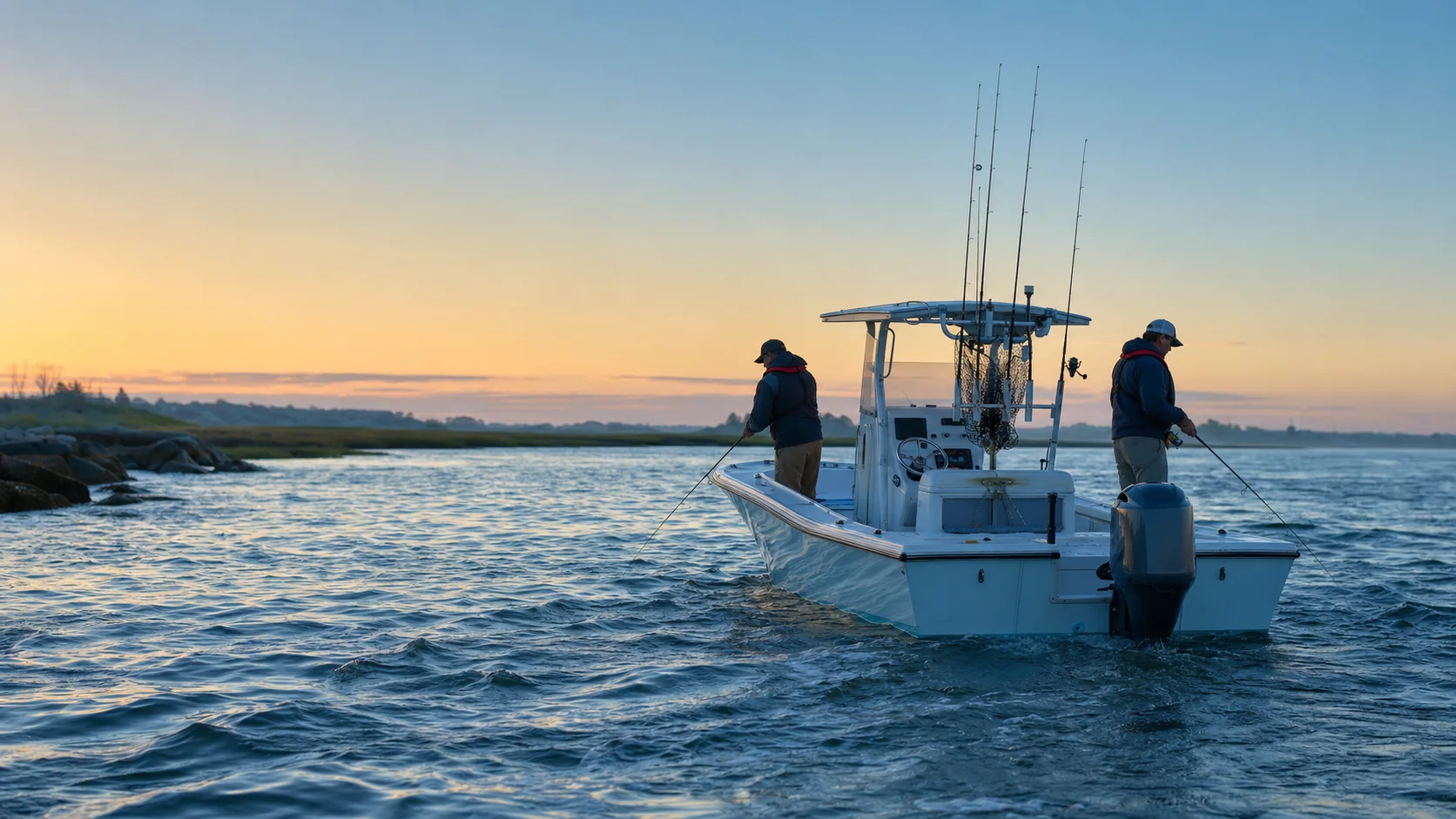
When wind and tide push the boat in different directions, diagnose the drift before blaming the bait. Watch the boat's track, line angle, bottom contact, traffic, and exit route. Change the starting point or boat angle first, adjust weight second, and move to a cleaner lane if the drift still will not settle.
A fluke rig can be perfectly tied and still fish badly. The boat slides sideways. Lines cross under the hull. One angler stays near bottom while the other scopes far behind. Every few seconds someone asks whether to add more weight.
That is usually a boat-control problem, not a color problem.
Wind against tide is common around Northeast bays, inlets, sounds, shoals, and nearshore structure. Current may pull the water one way while wind pushes the hull another. The result can be a crooked track, inconsistent speed, poor bottom contact, and a cockpit full of crossed lines.
The fix starts with one clean diagnostic drift.
What wind against tide does to the presentation
A useful fluke drift keeps the offering near bottom and moving through a defined lane. Wind against tide can break that setup in several ways:
- The hull moves across the current instead of with it.
- Bow and stern swing through different lines.
- One side of the boat gets a steep line angle while the other side scopes out.
- Rigs drag, lift, or tumble instead of working close to bottom.
- Anglers compensate with different weights until the spread becomes harder to manage.
- The boat crosses the edge too quickly or misses it entirely.
The tide prediction is only part of the picture. Local current can be delayed or redirected by channels, islands, harbor mouths, shoals, and bottom contours. NOAA notes that tides and currents are related but different measurements. Water level at a tide station does not automatically tell you the exact current at every nearby piece of structure.
Use the chart and prediction to plan. Use the boat’s actual track and the lines in the water to diagnose the drift.
Run one reference drift
Do not start by changing every rig. Pick one setup that can reach bottom without being absurdly heavy, then make a short pass over a safe, familiar lane.
Record five things:
- Boat track. Is the boat moving along the edge, across it, or in a curve?
- Hull angle. Is the bow leading, the stern leading, or is the boat sliding broadside?
- Line angle. Are the lines close to vertical, trailing cleanly, or disappearing under the boat?
- Bottom contact. Can the angler touch bottom, lift, and return without dragging continuously?
- Cockpit order. Can two anglers fish without crossing every few minutes?
That first drift does not have to produce a bite. It has to explain what the boat is doing.
Fix the lane before the lure
The cheapest adjustment is often the starting point. If the boat is sliding across the productive edge, begin farther upwind or up-current so the track reaches the structure instead of missing it.
Make one change at a time:
- Move the starting point.
- Change the boat’s initial heading.
- Shorten the pass to the section that actually fishes cleanly.
- Put anglers on the side that gives their lines the clearest path.
- Use brief, controlled engine corrections only when the operator can do so safely.
- Try a nearby lane with less conflicting wind or current.
A drift sock can help in some open-water situations, but it is not a universal answer. It adds another line and another piece of equipment to manage. Do not deploy one near heavy traffic, fixed structure, inlet turbulence, or anywhere it could interfere with the propeller or a fast exit. Use only gear and methods the operator understands.
Add weight only after the track improves
More weight can restore bottom contact, but it cannot turn a bad boat track into a good one. It can also make a rig drag, bury, snag, or become tiring to work.
Use enough weight to make a controlled presentation:
- Touch bottom.
- Lift the rig clear.
- Return it without a long uncontrolled drop.
- Feel changes in sand, shell, rubble, or hard bottom.
- Keep the line out of the propeller and away from other anglers.
If one angler needs much more weight than everyone else, compare position and line angle before rebuilding the rig. The stern, bow, port side, and starboard side may be fishing four different drifts on the same boat.
Thin braid can reduce water resistance, but line choice should match the tackle, knots, leader, target, and conditions. It does not replace boat control.
Match the rig to the corrected drift
Once the boat is tracking cleanly, the bait and lure choices become easier to judge.
A bucktail-and-teaser setup works when the angler can stay connected to bottom and give the rig deliberate movement. A bait rig can cover water well when it tracks naturally without spinning or dragging. Soft plastics and strip baits can add profile, action, scent, or durability, but they cannot rescue a presentation that spends half the drift well above bottom.
Keep the first comparison simple:
| Drift signal | First adjustment |
|---|---|
| Lines run under the hull | Change boat angle, angler position, or starting point |
| Lines trail too far back | Improve the track, then add only enough weight for contact |
| Rig drags continuously | Reduce weight or work the rig more deliberately |
| Everyone crosses at once | Shorten the drift and reorganize positions |
| Clean drift but no bites | Change depth, structure, profile, speed, or bait |
That order matters. A clean, bite-free drift gives useful information. A tangled drift gives almost none.
Repeat the exact productive section
When a bite comes, mark the lane rather than the general area. Note the depth, bottom change, boat heading, tide stage, and line angle.
Then repeat the pass from the same starting relationship to wind and current. Do not simply circle back to the waypoint and assume the next drift will follow the same track. Wind can build, current can turn, and boat traffic can force a different line within minutes.
A short repeatable pass usually teaches more than a long wandering drift.
Know when to move
Some wind-against-tide setups never become clean enough to fish well. Move when:
- the inlet or channel is rougher than the crew or boat can safely handle;
- traffic makes repeated drifts unsafe;
- every correction pushes the boat toward rocks, shoals, markers, or anchored boats;
- weeds or debris foul every presentation;
- the wind trend is worsening the return trip;
- the crew cannot maintain bottom contact without excessive weight;
- the cockpit cannot stay organized.
Protected water, a different side of the bay, a channel running at another angle, or a later tide may fish better. The famous piece of structure is not worth forcing when the boat cannot make a safe, controlled pass.
Kayak anglers need an even stricter threshold. Wind, current, boat traffic, cold water, and distance from the launch can compound quickly. Wear the appropriate personal flotation device, stay within the craft’s and paddler’s limits, and keep enough reserve for the trip home.
A six-minute reset
When the drift falls apart, use this reset before opening another tackle tray:
- Reel every line in.
- Move clear of the active lane and traffic.
- Compare wind direction with the observed current.
- Pick a shorter, safer starting line.
- Send one reference rig down.
- Add anglers only after the first line fishes cleanly.
If the reference rig cannot hold bottom cleanly, relocate. If it can, rebuild the spread around that working angle.
The trip-planning version
Check the marine forecast and tide prediction before leaving, then write down a primary drift and a protected backup. The site’s Fishing Reports and Tides page and Northeast Fishing Trip Planner can organize the first pass. The fluke and sea bass structure plan can help pick edges worth testing.
Once on the water, trust the actual track. Wind against tide is not a cue to keep adding tackle. It is a cue to slow the decision down, restore control, and make one drift that can be repeated.
Plan a cleaner boat day
Check wind, tide, reports, structure, and a protected backup
Build the trip before the ramp, then adjust the drift from what the boat and lines are doing on the water.