
Field Note
The Striped Bass Slot Limit Fight Is Really a Trust Problem
A sharp, source-grounded look at why striped bass anglers are angry about the 28-31 inch slot limit, commercial quotas, release mortality, and the politics around rebuilding the stock.
Updated June 18, 2026
The short answer
The striped bass slot-limit fight is not just about inches. It is about trust.
Recreational fishermen are being told to live inside a narrow slot, often one fish between 28 and 31 inches in ocean waters, while commercial harvest is discussed in quotas, pounds, tags, trip limits, and state allocations. That difference in language alone makes the system feel rigged, even when the broader data shows the recreational side is responsible for most striped bass removals.
That is the controversy. Conservation is real. The stock still needs protection. But the politics around striped bass have become a public trust problem, and regulators should stop pretending the anger is only about people wanting to kill more fish.
The uncomfortable version: a one-fish slot limit feels personal. A commercial quota feels institutional. When the stock is stressed, that gap turns every dock, ramp, Facebook thread, and fisheries meeting into a courtroom.
The slot limit is not the villain
There is a reason striped bass rules tightened.
The Atlantic States Marine Fisheries Commission’s 2024 stock assessment update said the resource was not experiencing overfishing, but it was still overfished. Female spawning stock biomass in 2023 was estimated at 191 million pounds, below the 197 million pound threshold and the 247 million pound target. The same update warned that the probability of rebuilding by 2029 was less than 50% under the scenario being reviewed.
That is not something serious anglers should wave away. If the spawning stock is not rebuilt, every sector loses. Surfcasters lose nights. Charter captains lose business. Commercial boats lose quota value. Tackle shops lose traffic. Restaurants lose local fish. Kids lose a fishery that should have been handed down better than this.
So yes, conservation matters. It is not a slogan. It is the price of still having striped bass worth fighting over.
The problem is that the current politics ask anglers to absorb conservation pain while trusting a management system many of them do not understand, do not see, and do not fully believe.
Why anglers are angry
The anger usually starts with a simple scene.
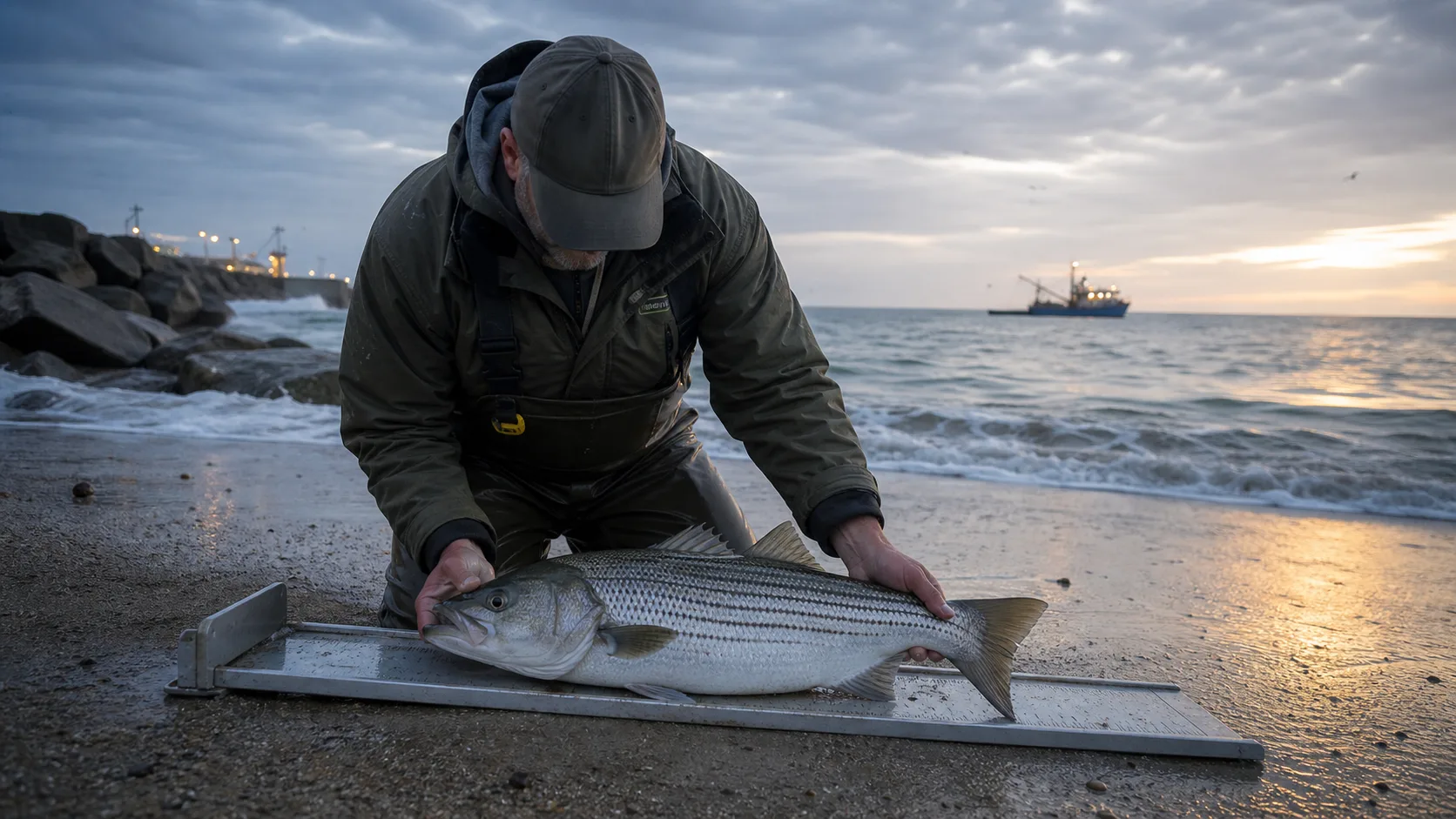
A recreational angler catches a healthy 32-inch bass and has to release it. Maybe that fish swims away strong. Maybe it does not. Then that same angler hears that commercial boats have a quota measured in pounds and thinks, “So I have to throw this fish back, but somebody else can sell theirs?”
That reaction is emotionally obvious, but the full picture is messier.
NOAA says recreational harvest of striped bass regularly exceeds commercial harvest, and in 2024 recreational harvest totaled about 15 million pounds. NOAA also lists 2024 commercial landings from state waters at almost 4 million pounds. ASMFC’s Addendum III says that from 2020 through 2024, the commercial sector accounted for about 13% of total removals by number, while the recreational sector accounted for about 87%.
Those numbers matter because they break the easiest version of the argument. It is not honest to say commercial boats are the only pressure on striped bass. They are not.
It is also not honest to tell recreational anglers they are imagining the fairness problem. They are not.
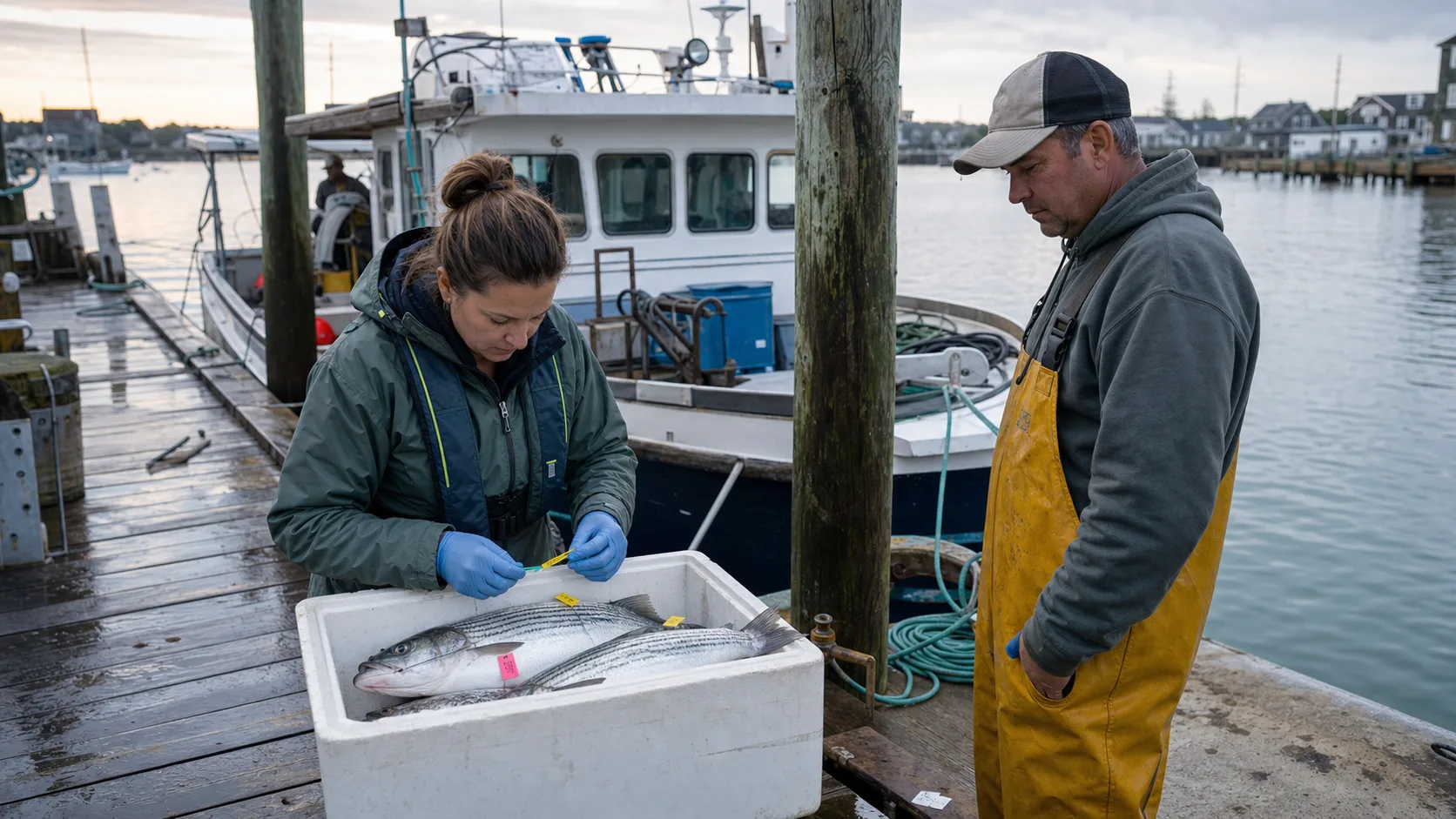
The recreational side is asked to carry a rule that feels blunt and visible. The commercial side is managed through a system that feels technical and less visible. Pounds. Tags. State quota shares. Transfer rules. Reporting. Enforcement. Landing points. Commercial closures. Gear rules. That may be normal fisheries management, but normal does not mean trusted.
The commercial quota issue cuts both ways
Commercial striped bass fishing is not a free-for-all. It is quota-managed in state waters. Federal waters remain closed to commercial and recreational striped bass fishing.
ASMFC’s Addendum III describes two broad commercial quota regions: ocean and Chesapeake Bay. In 2024, the ocean commercial quota was 2.2 million pounds, with roughly 1.7 million pounds harvested. The Chesapeake Bay commercial quota was 2.8 million pounds, with roughly 2.6 million pounds harvested. The same document says New York and Maryland’s ocean fishery exceeded their state quotas in 2024, while Maryland also exceeded its Chesapeake Bay quota share even though the full Bay quota was not exceeded.
That is exactly the kind of detail that fuels unrest. A coastwide quota can look acceptable while a state quota overage looks unacceptable to the people fishing next to it.
The commercial side will argue, fairly, that it is often held to hard pounds, tags, trip limits, seasons, gear rules, and closed days. Recreational anglers will argue, also fairly, that a narrow slot backed by uncertain catch estimates and release mortality assumptions can feel like punishment without precision.
Both sides have a point. That is why the politics are so bitter.
Release mortality is the part nobody likes talking about
Catch-and-release is not impact-free.
ASMFC uses an assumed 9% mortality rate for striped bass released alive. In 2024, Addendum III says recreational anglers caught and released an estimated 19.1 million striped bass, with 1.7 million assumed to have died from being caught.
That number is why managers care about no-harvest, no-targeting, season closures, circle hooks, slot limits, and effort. It is also why anglers get defensive. A guy releasing a fish in the wash does not feel like a commercial landing. But at coastwide scale, release mortality becomes real removals.
This is where the debate needs to grow up.
Recreational fishermen cannot demand conservation credibility while pretending release mortality does not exist. Managers cannot demand trust while speaking about recreational mortality in estimates and commercial landings in hard dockside numbers without explaining uncertainty clearly. Commercial operators cannot ask for public support while opposing every transparency improvement. Conservation groups cannot treat access as if it is disposable.
Everybody wants to be the victim. The bass do not care.
The politics are not random
ASMFC approved Addendum III without reducing fishery removals for 2026. The Board decided not to move forward with a proposed 12% reduction after reviewing preliminary 2025 recreational catch estimates, which were lower than anticipated. It also said more than 4,000 public comments on the draft addendum were sharply divided, and the Board itself was divided.
That is political unrest in the fishery sense. Not party politics. Not cable-news theater. A real split between people who all claim to care about striped bass but disagree on who should give up what, when, and why.
The tension has been building for years because the slot limit changed how people experience the fishery. A 28-to-31-inch keeper window means a lot of fish that feel like table fish are released. It also means legal fish become a narrower target. That can increase frustration, increase handling, and make anglers feel like the rule is chasing one year-class through the population instead of rebuilding the whole fishery.
ASMFC has acknowledged part of that issue. Addendum III says a standard straight-line total length measurement, with the tail squeezed together, will apply to both sectors. States that do not already have that definition in place have until January 1, 2027 to update regulations. That matters because narrow slot limits only work if everyone measures the same fish the same way.
It also changed commercial tagging requirements. States will have to tag commercially harvested fish by the first point of landing. Some states have until the end of 2028 to make the transition. ASMFC said the change addresses concern that waiting until point of sale could increase illegal-harvest risk.
Those are not small details. They are trust repairs.

What fishermen actually expect
Most fishermen do not expect unlimited harvest. They expect a system that feels honest.
They expect conservation to be honored because a collapsed fishery helps nobody. They expect commercial accountability to be visible, fast, and enforced at landing, not buried downstream. They expect recreational rules to account for real behavior on real water, including heat, deep hooks, crowding, tournaments, charter effort, and the difference between targeting and incidental catch. They expect managers to explain uncertainty instead of hiding behind acronyms. They expect poaching to be treated as theft from everyone.
Most of all, they expect shared sacrifice to look shared.
That is why the slot limit keeps becoming a flashpoint. It is the rule people can feel in their hands. The quota system is the rule they hear about after the fact.
The argument that needs to stop
The worst argument in striped bass politics is that conservation and access are enemies.
They are not.
A rebuilt spawning stock protects access. Sensible access keeps anglers invested in conservation. Transparent commercial rules protect lawful commercial fishermen from being lumped in with bad actors. Better recreational handling protects the fish anglers claim to respect. Enforcement protects every honest person in the fishery.
The better argument is harder and less viral: striped bass management should be conservative enough to rebuild the stock, transparent enough to be trusted, flexible enough to reflect regional fishing patterns, and strict enough that illegal harvest becomes a bad bet.
That means anglers may have to accept rules they dislike. It also means managers have to stop acting surprised when people reject a system they cannot see.
The way out
The way out is not another round of slogans.
Publish clearer public dashboards showing recreational estimates, release mortality assumptions, commercial quotas, commercial landings, quota transfers, closures, enforcement actions, and state overages in plain language. Explain why the slot is where it is. Explain what would trigger change. Show what happened after each season. Make the commercial tagging timeline visible. Make measurement rules consistent. Treat poaching as a direct attack on the public fishery. Give anglers credit when reduced effort or better handling helps.
Then hold the line on conservation.
That last part matters. Rebuilding striped bass should not depend on which side yells loudest in a meeting. The stock either rebuilds or it does not. The spawning stock either supports the future fishery or it does not.
But the politics matter too, because people obey rules they trust faster than rules they resent.
The striped bass slot-limit fight is not going away because it sits on top of a deeper question: who gets to take fish from a public resource, under what rules, with what proof, and with what consequence when the line is crossed?
Until that question is answered in a way fishermen can see, every 31-inch bass released at the beach will keep feeling like a political statement.
Sources checked
This article was checked against primary public sources on June 18, 2026, including ASMFC’s Atlantic striped bass stock assessment and Addendum III materials, NOAA Fisheries’ Atlantic striped bass species page, NOAA’s federal recreational regulations page, and New York State DEC’s saltwater fishing regulations page. Current regulations can change, so verify state rules before harvesting a striped bass.
Source links: ASMFC 2024 stock assessment update, ASMFC Addendum III press release, ASMFC Addendum III PDF, NOAA Atlantic striped bass, NOAA recreational regulations by species, and NYSDEC recreational saltwater regulations.