
Field Note
AI Agent Testing Is the New Operating Discipline
AI agent testing is now an operator problem: define tasks, evidence, approval gates, regression checks, and production stop rules before agents touch customers.
Updated June 29, 2026
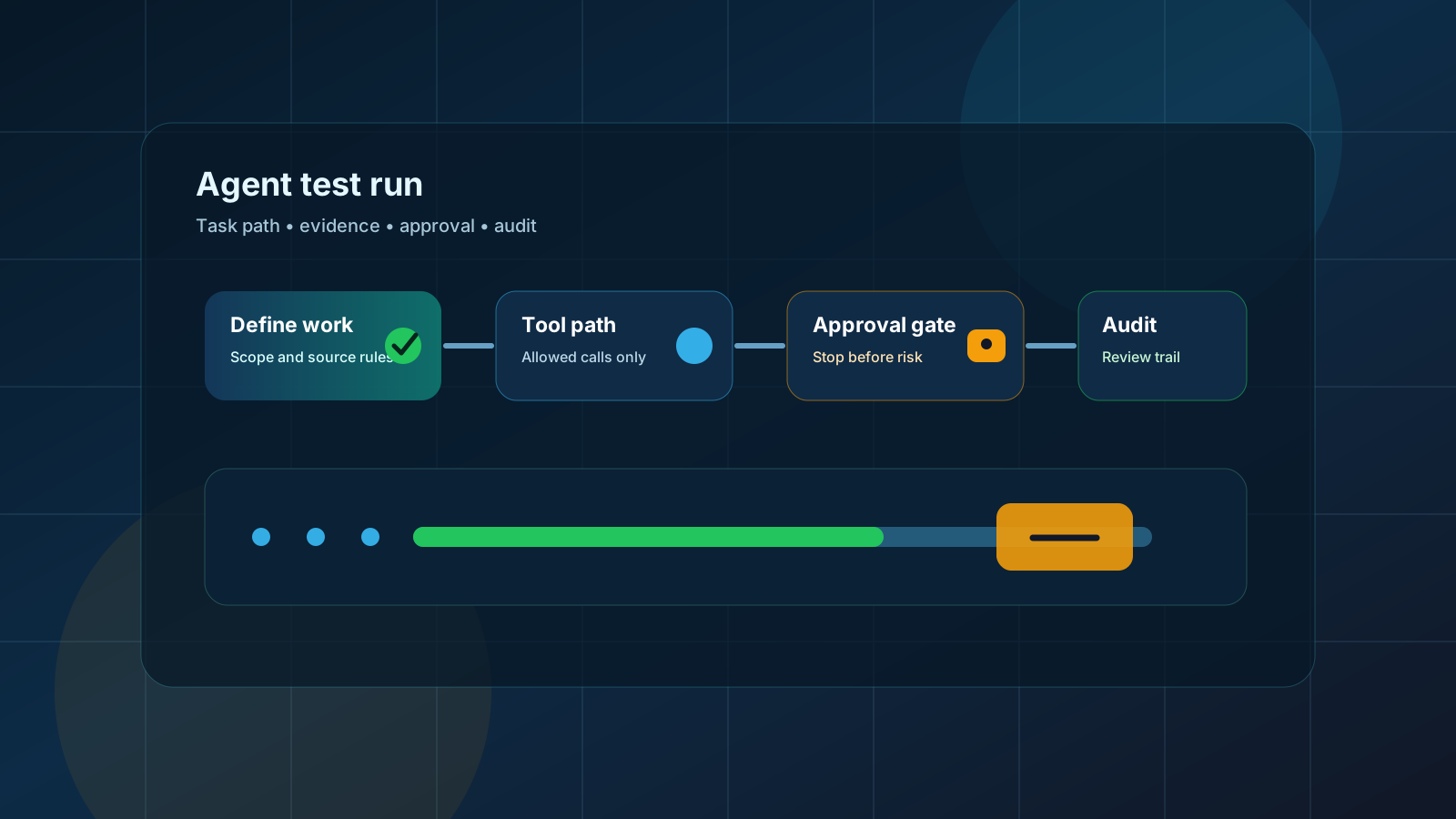
The short answer
AI agent testing is becoming the new operating discipline.
The first wave of agent adoption asked, “Can this model use tools and finish a task?” The more useful question is now, “Can the business prove this agent is safe, useful, current, bounded, and recoverable when the workflow gets messy?”
That shift matters because agents are not ordinary content generators. They plan, call tools, move across systems, ask for information, make intermediate decisions, and sometimes leave behind state that other people depend on. IBM’s June 2026 overview of AI agent testing frames the issue plainly: testing has to evaluate how agents plan, act, use tools, and respond under real-world conditions before deployment. That is the right lens for operators.
The companies that win with agents will not be the companies that run the most demos. They will be the companies that test the work like operations, not like a prompt contest.
Why agent testing is different from prompt testing
Prompt testing usually asks whether a model produced a good answer.
Agent testing has to ask whether a system behaved correctly across a chain of work.
That chain can include retrieval, reasoning, tool use, handoff, escalation, approval, data entry, outbound communication, and post-run logging. A final answer can look polished while the path that produced it was wrong. The agent may have used the wrong source, skipped a required approval, failed to preserve evidence, retried a tool call too aggressively, or reached the right recommendation for the wrong reason.
That is why agent testing cannot stop at output quality. The workflow path matters.
Anthropic’s guidance on building effective agents makes a useful distinction between workflows, where code paths are more predefined, and agents, where the model dynamically directs parts of the process and tool use. That difference is exactly why testing has to get more operational. The more autonomy the system has, the more the business needs a test harness around decision paths, permissions, evidence, and recovery behavior.
The operator-grade test stack
A practical agent test stack does not need to be theatrical. It needs to answer five questions before the agent touches real customers, revenue, public claims, or operational records.
1. What work is the agent allowed to own?
Start with a narrow work packet.
Do not test an agent against a vague ambition like “handle customer success” or “run sales follow-up.” Test it against a bounded job: classify an inbound lead, draft a renewal summary, reconcile a shipping exception, prepare a weekly account-risk note, or extract action items from a vendor thread.
The test should name the business outcome, source systems, allowed tools, prohibited actions, approval threshold, and final recording path. If those items are unclear, the test is already telling you the workflow is not production-ready.
2. What evidence must the agent preserve?
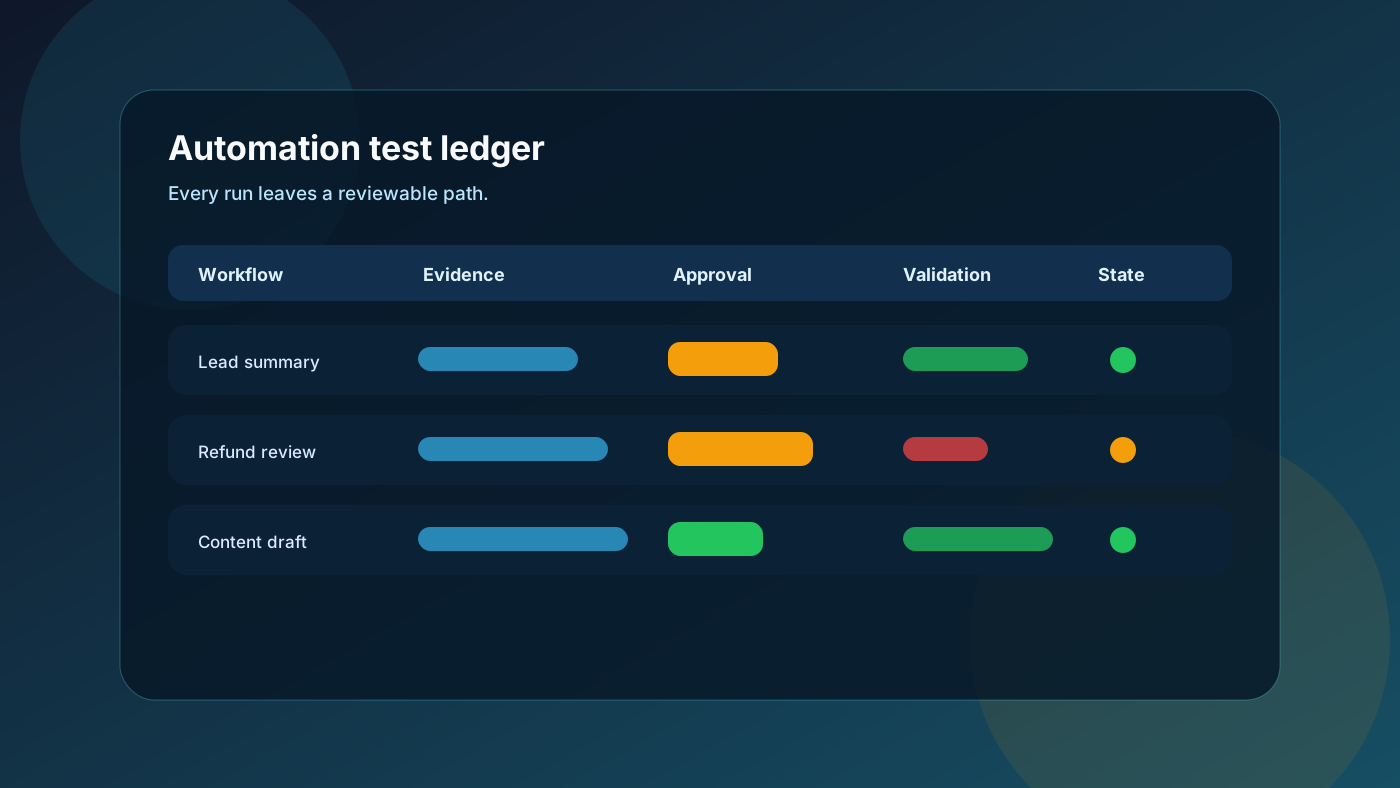
Every meaningful agent run should leave an evidence trail.
That does not mean dumping a full chat transcript into a database. It means preserving enough proof for a human to inspect what happened: inputs used, sources consulted, tool calls made, records changed, assumptions made, approvals requested, validation checks passed, and exceptions encountered.
Evidence is what turns automation from magic into management. Without it, leaders end up debating whether the agent “seems good.” With it, operators can see where the system is reliable, where it is brittle, and where the human process is still carrying the load.
3. Where does a human have to approve?
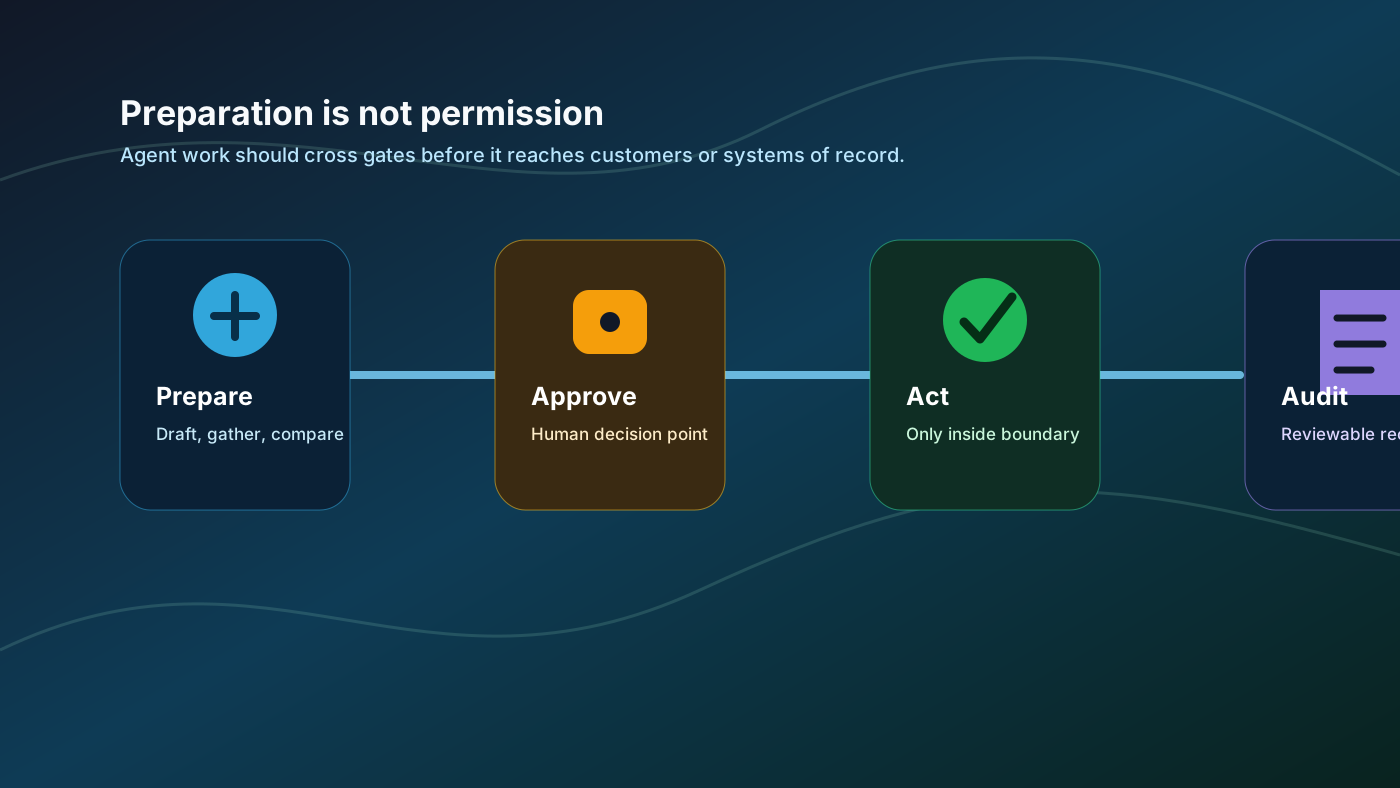
Human-in-the-loop is not a slogan. It is a decision boundary.
If the agent can draft a customer response but not send it, say that. If it can prepare a refund recommendation but not issue the refund, say that. If it can update a CRM note but not change a deal stage, say that. If it can summarize a compliance-sensitive document but not make a claim about policy, say that.
The test should include cases that force the agent to stop. A safe agent is not one that always finishes. A safe agent is one that knows when the work has crossed its authority.
4. What regressions can break the workflow?
Agentic workflows decay.
Models change. APIs change. policies change. Product names change. Approval thresholds change. Data schemas change. Internal language changes. A prompt that worked in May may become risky in July because the source of truth moved or the business rule changed.
That means the test stack needs regression cases. Keep a small set of realistic examples: easy cases, messy cases, edge cases, adversarial cases, and must-escalate cases. Run them whenever you change the prompt, model, tool permissions, data source, or approval policy.
The goal is not to freeze innovation. The goal is to notice when a change quietly weakens the workflow.
5. What is the stop rule?
Production systems need stop rules.
An agent should not keep acting when source data conflicts, a tool returns partial results, a permission check fails, a customer-facing claim lacks support, a money movement is involved, or a required approval is missing. The right result may be a clean escalation, not a completed task.
This is where many teams confuse autonomy with usefulness. More autonomy is not always better. The better system is the one that completes safe work quickly and stops dangerous work early.
Three practical examples
Sales follow-up agent
A sales agent that drafts follow-up emails should be tested on more than tone.
The test should verify that the agent uses the correct account history, does not invent pricing, respects opt-out rules, preserves the source notes behind its recommendation, and escalates when a prospect asks for a contractual exception. The pass condition is not “the email sounds good.” The pass condition is “the email is supported, bounded, and safe to review or send under the defined rule.”
Operations exception agent
An operations agent that triages shipping or service exceptions should be tested against conflicting records.
One system may show a shipment delivered. Another may show a delayed scan. A customer may say the package is missing. The test should force the agent to reconcile sources, identify uncertainty, avoid unsupported promises, and route the case to a human when the next action affects cost, refund, replacement, or reputation.
Content operations agent
A content agent that researches and drafts articles should be tested for source integrity.
It should separate source-backed claims from interpretation, avoid copying source language, reject weak sources, preserve links consulted, and flag when a claim needs a stronger citation. The output matters, but the research trail matters more. A pretty article with fabricated support is an operational failure.
What to measure before production
Do not start with vanity metrics.
Start with the measurements that tell you whether the workflow can be trusted.
| Test area | What to check | Why it matters |
|---|---|---|
| Task success | Did the agent complete the defined work packet? | Prevents vague demos from being counted as production capability. |
| Source fidelity | Did it use the correct sources and cite or preserve them? | Reduces invented claims and stale-source risk. |
| Tool behavior | Did tool calls happen in the allowed order with safe parameters? | Protects systems, data, permissions, and downstream records. |
| Escalation quality | Did the agent stop when authority or evidence was insufficient? | Makes human review a real control, not decoration. |
| Recovery | Did the workflow handle tool failure, missing data, and conflicting inputs? | Real operations fail in ordinary ways. The agent has to degrade safely. |
| Auditability | Can a reviewer understand what happened after the run? | Turns automation into something managers can inspect and improve. |
OpenAI’s Agents SDK documentation is a useful signal here because it treats tracing, guardrails, handoffs, and sessions as first-class concerns. Those are not merely developer features. They are operating features. They help the business see and control what the agent is doing.
The testing mistake leaders will make
The predictable mistake is testing agents like software demos instead of business processes.
A demo path says: here is a happy-case task, here is the agent completing it, here is the impressive result.
An operating path says: here are the allowed jobs, here are the failure cases, here are the evidence requirements, here are the approval gates, here are the regression examples, here is the stop rule, and here is what happens when the agent is wrong.
The second path is less flashy. It is also the path that survives contact with customers.
A simple pre-production checklist
Before an agent goes live, answer these questions in writing:
- What exact work packet is in scope?
- Who owns the business outcome?
- Which sources are authoritative?
- Which tools can the agent use?
- Which actions are prohibited?
- What evidence must be stored?
- What cases require human approval?
- What regression examples must pass before release?
- What failures force a stop or escalation?
- How will the team review the run after it happens?
If the team cannot answer those questions, the agent is not blocked by model capability. It is blocked by operating discipline.
Read next on SteveFraney.com
If you are building agentic workflows, start with the operating layer before you chase more autonomy:
- AI Agents Need an Operating Layer, Not Another Demo
- The AI Automation Ledger: The Missing System Between Prompts and Profit
- AI Agents Won’t Save Broken Operations. They’ll Expose Them.
Sources consulted
- IBM: AI Agent Testing
- IBM: What is AI Agent Evaluation?
- Anthropic: Building effective agents
- OpenAI Agents SDK documentation
- Google Cloud: What are AI agents?
- Google News RSS scans for current AI agent, agentic AI, and AI automation headlines on June 29, 2026.
The operator takeaway
AI agent testing is not just a technical quality step. It is how the business decides whether an automation deserves authority.
The useful posture is simple: let agents move fast inside tested boundaries, require proof when work matters, and make escalation a feature instead of an embarrassment.
That is how agentic workflows become infrastructure instead of theater.
Operator next step
Build the test ledger before you scale the agent.
Pick one workflow, define the evidence, write five regression cases, and decide exactly when the agent must stop for human review.